
Silestone General Contractor in Westminster: A Homeowner’s Guide
Silestone countertops fail at the cabinet boxes, not the slab. The manufacturer’s warranty requires a substrate flat within 1/8 inch over 10 linear feet. A countertop-only fabricator never touches that substrate. A general contractor does, and that changes everything about how your Silestone install should be managed in Westminster.
If you’re weighing options, our General Contractor in Westminster page walks through the full-scope difference.
Why Silestone’s Warranty Makes Cabinet and Countertop Scopes Inseparable
Cosentino, the Spanish manufacturer behind Silestone, writes its warranty into stone. The surface must sit on a substrate that is flat within 1/8 inch over any 10-foot span. That tolerance comes from the cabinet boxes, the leveling shims, and the plywood underlayment, none of which are visible once the slab goes down.
Here’s what that means in a real Westminster kitchen. A 12-foot run of base cabinets that sags 3/4 inch in the middle will transfer stress to the Silestone slab. Quartz does not flex. Under enough tension from an uneven substrate, it cracks. The warranty won’t save you because the failure began below the surface, outside the slab’s control.
A general contractor roughs in cabinets knowing the countertop tolerance is coming. We check cabinet tops with a 10-foot straightedge before the template appointment. We shim low spots, plane high ones, and confirm the sink base is dead level before the laser template team arrives. A countertop-only shop shows up to measure what’s there. If what’s there is wrong, they cut to it and the crack becomes a later conversation.
When we scope a Home Remodeling in Westminster project, the cabinet and countertop installs are one line item with one accountability chain. That’s not a convenience. It’s the difference between a warranty that holds and one that evaporates.
Silestone Series Comparison: Eternal, Stellar, and Lyra in Westminster Kitchens
Silestone runs three residential series, and the right pick depends on what your Westminster home needs to do for you.
- Eternal Series: The classic Silestone line. Wide color range, traditional polished finish, and the standard 25-year warranty. Most Westminster homeowners choose Eternal for rental properties, flips, and kitchens where proven performance matters more than trend. Colors like Blanco Zeus and Desert Silver show up constantly in Westminster remodels because they read as neutral without being boring.
- Stellar Series: This is the series with the larger particulates and a softer, more organic surface feel. Stellar finishes lean matte and low-gloss, which hides fingerprints and hard water spotting better than polished Eternal. For busy Westminster households with kids and hard water, Stellar’s finish profile is a practical upgrade without a dramatic price jump.
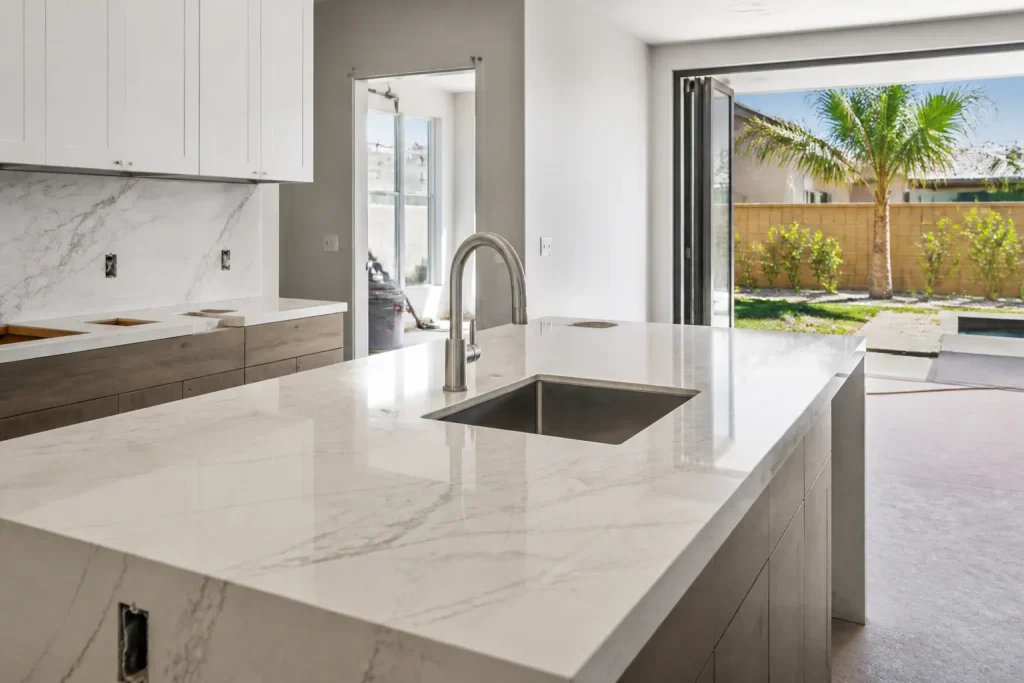
- Lyra Series: The veined, marble-look series. Lyra mimics Calacatta and Statuario marble with grey and gold veining that reads high-end. It’s the series you choose when you want the look of natural stone without the etching and sealing. In Westminster’s mid-century and Spanish-style homes, Lyra veining works especially well with warm cabinet tones.
Pricing moves upward from Eternal through Stellar to Lyra. A typical Westminster kitchen with 45 square feet of countertop costs between $3,800 and $5,900 installed for Eternal, $4,400 to $6,600 for Stellar, and $5,200 to $7,400 for Lyra, depending on edge profile, sink cutouts, and the fabrication shop’s rates. These are material and labor ranges we’ve seen in Westminster over the past two years.
For a full project view, see our Home Renovation in Westminster page.
Plumbing Rough-In: The Cutout Specs Most Homeowners Never See
Silestone requires specific minimum bridge widths between the sink cutout and the front edge of the slab. For most undermount kitchen sinks, that bridge is 2 inches minimum. For some farmhouse and apron-front sinks with heavy cast iron, it’s 3 inches. The faucet holes also have minimum spacing from the sink rim, typically 2 to 4 inches depending on the fixture.
None of these numbers are the homeowner’s problem until they are. Here’s the sequence when we manage a Silestone install in Westminster:
- The sink and faucet get specified before the template appointment, not after.
- The fabricator receives the plumbing fixture cutouts from the manufacturer’s spec sheet, not from a tape measure held up to a box.
- The plumber roughs in the supply lines and drain to match the cabinet layout and the planned sink position.
- The template technician confirms the bridge widths and edge overhang before cutting.
- The slab is fabricated, delivered, and set. The plumber returns to make final connections only after the Silestone is down.
When a countertop-only shop handles the slab, they ask you for the sink specifications. If you bought the wrong faucet drill pattern, you find out after the slab is cut. A GC pulls the plumbing scope and the countertop scope under one schedule, so the bridge widths are checked against the actual fixture before a diamond blade ever touches the stone.
Ordering Silestone Through a Fabricator vs. a General Contractor: The Hidden Cost
The fabricator’s quote looks cheaper because it covers less. A Westminster countertop shop quotes the slab, the template, the fabrication, and the install. That’s it.
What they don’t quote:
- The cabinet leveling and substrate correction we discussed above. If the cabinets are out of tolerance, the fabricator charges extra to install over it, or refuses the job, or installs it and the warranty dies silently.
- The plumbing disconnect and reconnect. Unless you schedule your own plumber around the countertop crew, the sink sits disconnected for days or weeks.
- The backsplash transition. Silestone ends at the wall. Tile, window trim returns, and outlet relocations are separate trades with separate schedules.
- The disposal and demolition of the old countertop. Some shops haul it; some leave it in your driveway.
- Any damage to drywall, cabinet faces, or flooring during the install. Countertop shops are not drywall crews.
When we bundle Silestone into a full kitchen scope through Square One Builders home, those line items are already in the plan. The cabinet crew levels before the template. The plumber is scheduled before and after the stone goes in. The backsplash tile is a continuation of the same job, not a separate phone call. The total project number looks higher because it includes every step, not just the slab.
We pulled a Silestone install out of a home in central Westminster last year where the previous fabricator had cut the sink bridge at 1.5 inches. It cracked at the front lip two months after install. The homeowner had no recourse because the fabricator hadn’t touched the cabinets, and the slab had been set on an uneven run. That’s what a siloed scope costs.
What the Installation Sequence Looks Like Under One Team
A GC-managed Silestone installation in Westminster follows a sequence that prevents problems rather than reacting to them.
- Cabinet rough-in and leveling: Base cabinets are installed, shimmed, and checked against the Silestone flatness tolerance. Any corrections happen now, before the template.
- Fixture specification: The sink, faucet, and any cooktop receive final approval. Cutout specs go to the fabricator.
- Template appointment: The fabricator lasers the entire run, including the corrected substrate. No surprises because the substrate is already known-good.
- Plumbing rough-in: Supply lines and drain are positioned to match the planned sink location, not moved after the fact.
- Fabrication: The slab is cut, edge-profiled, and polished offsite. Typical turnaround in Westminster is 5 to 10 business days depending on the fabricator’s queue.
- Delivery and set: The slab is placed on the prepared cabinets, checked for level and seam tightness, and adhered. A quality seam should be visible only as a hairline.
- Plumbing final: The sink drops in, the faucet mounts, and the plumber connects and tests everything.
- Backsplash and finish: Tile or Silestone backsplash goes up, outlets get adjusted, and the final sealant line runs along the back edge.
When one team owns every step, the template never surprises anyone. That’s the point of doing this from the ground up.
When to Call a GC Instead of a Fabricator Directly
If your cabinets are new or in factory condition, the surface is a simple rectangle or L-shape with one sink cutout, and you already have a plumber you trust, a direct fabricator order can work. It’s not the wrong path, and we won’t pretend otherwise.
But call a GC-managed Silestone install in Westminster when:
- The cabinet boxes are older, modified, or previously installed by someone else. The substrate risk is real.
- The kitchen is part of a larger remodel that includes flooring, lighting, or wall changes. Stone should arrive after the structure settles.
- You’re changing sink locations or faucet configurations. The bridge widths and rough-in positions need to be coordinated ahead of time.
- You want one accountable party when anything goes wrong. If the countertop cracks, the sink leaks, and the backsplash gaps, a GC fixes all three. A fabricator, a plumber, and a tiler blame each other.
In Westminster, we’ve also managed Silestone installs in ADU kitchens built through our prefab partnerships with companies like Dvele and Mighty Buildings. Those projects move fast, and the countertop scope has to drop into a compressed schedule without losing the flatness check. When the structure is prefabricated and the kitchen is installed in a week, the cabinet substrate tolerance matters even more, not less.
The Bottom Line
Silestone is a premium quartz surface with a warranty that reaches below the slab into the cabinet boxes. The most important step in a Silestone install in Westminster is the one that happens before the stone arrives. If the substrate is flat, the warranty is intact, the seams are tight, and the bridge widths hold. If it isn’t, no fabricator’s skill saves the slab.
Managing that substrate is a general contractor’s job. It’s a cabinet scope, a plumbing scope, and a countertop scope wrapped into one sequence. Choose the contractor who owns all three.
If you’re in Westminster and planning a kitchen with Silestone, Square One Builders offers free estimates. Call (877) 688-9930 and we’ll walk your kitchen, check the substrate, and give you a straight answer on scope and cost.
Frequently Asked Questions
Silestone countertops in Westminster typically run $85 to $165 per square foot installed, depending on the series. Eternal Series runs $85 to $130, Stellar runs $95 to $145, and Lyra runs $115 to $165 per square foot. A standard 45-square-foot kitchen lands between $3,800 and $7,400. Call (877) 688-9930 for a line-item quote specific to your kitchen.
No. Silestone is a quartz surface with resin binders, so it is non-porous and never needs sealing. That’s one of the main reasons Westminster homeowners choose it over granite and marble, especially in kitchens that see daily use.
Not properly. Silestone requires a flat, structural substrate, and laying it over existing laminate or tile creates the exact unevenness that voids the warranty. The old surface needs full demolition and the cabinet tops need leveling before the slab goes down.
From template to finished install, plan on 7 to 14 days. Templating takes one hour, fabrication runs 5 to 10 business days depending on the shop, and the set plus plumbing final typically takes one full day. A GC-managed install keeps that sequence on schedule because the substrate work happens before the template, not after.
Written by the team at Square One Builders, serving Westminster since 2014.
Need Construction Help?
Call Square One Builders — licensed & insured, here with fast after-hours help in Corona.
(877) 688-9930